

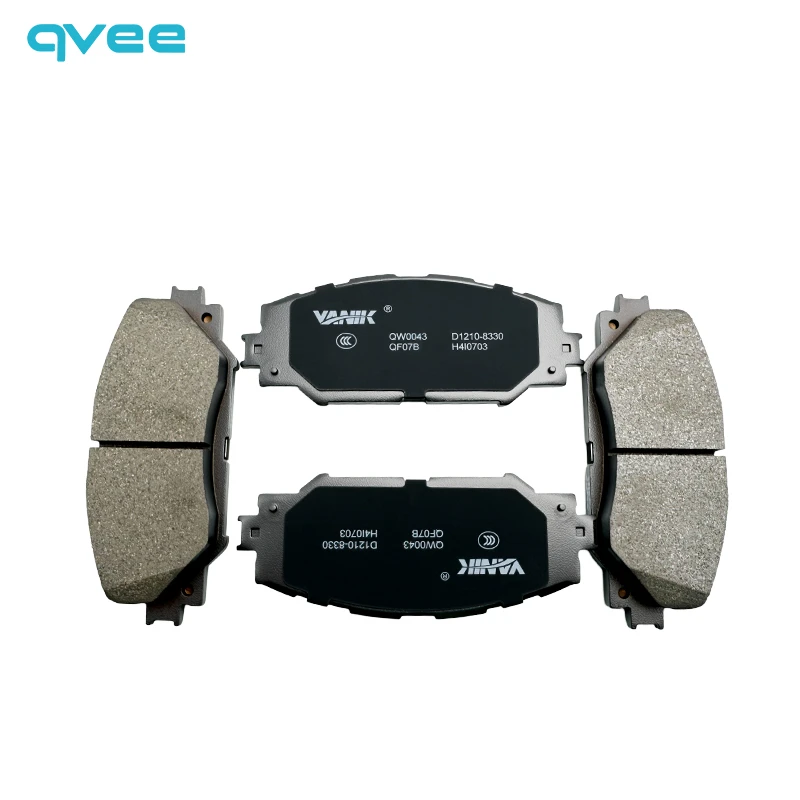
Ceramic Brake Pads are high‑end braking accessories manufactured from composite materials including ceramic fibres, silicon carbide and bonding resin. Compared with traditional semi‑metallic and powder‑metallurgy brake pads, they deliver prominent strengths in braking performance, user experience, durability and vehicle compatibility, and serve as mainstream upgrade parts for mid‑to‑high‑end cars and modified vehicles. Their core advantages are reflected in five aspects. First of all, they possess excellent high‑temperature resistance and anti‑thermal‑fade capacity. Conventional metallic brake pads suffer obvious thermal fade above 300℃ with greatly decreased braking force, which creates potential risks of brake failure during continuous high‑speed braking and downhill deceleration. By contrast, Ceramic Brake Pads can withstand temperatures ranging from 600℃ to 800℃. Their friction coefficient remains stable under regular and intensive braking conditions without braking‑force decline or brake softness caused by heat. Safety margins are significantly enhanced for complex road conditions such as highway travel and mountain driving.
Secondly, they maintain high cleanliness and cut overall maintenance costs. Traditional metallic brake pads generate large volumes of black metallic dust during braking. Such dust adheres firmly to wheel hubs and is hard to clean, and may corrode hub paint after long‑term accumulation. In comparison, Ceramic Brake Pads produce light‑coloured ceramic powder with low adhesive force, which disperses naturally while driving. Wheel hubs stay clean without frequent washing, which reduces appearance‑related maintenance workload. Moreover, no metallic debris is created during friction, so scratch damage to brake rotors can be avoided. Service life of rotors is extended and replacement frequency drops, resulting in lower comprehensive long‑term maintenance expenses.
Thirdly, they offer favourable braking feedback and outstanding noise suppression. The uniform and fine friction material of Ceramic Brake Pads ensures linear and soft braking response. Moderate pedal pressure generates even braking force. There is no weakness at initial braking or abrupt engagement that often appears on metallic brake pads. Precise and smooth pedal feel improves riding comfort greatly. Frictional noise is minimised, eliminating harsh metallic squeals occurring on metallic brake pads during cold‑start, low‑speed and reverse braking. Quiet operation is achieved in commuting, low‑speed following and reverse‑braking scenarios.
Fourthly, they feature long service life and superior wear resistance. Ceramic composite materials deliver high hardness and low wear loss with stable physical properties that are barely affected by temperature and humidity. The service life of ordinary semi‑metallic brake pads ranges from 30,000 to 50,000 kilometres, while Ceramic Brake Pads can reach 80,000‑100,000 kilometres under regular family‑car operating conditions. Their service life still surpasses metallic counterparts even under heavy‑duty circumstances. Replacement intervals are extended and time and money spent on vehicle maintenance are saved. Fifthly, weight reduction benefits vehicle handling. Ceramic Brake Pads of identical specifications are 40%‑60% lighter than metallic ones. Reduced unsprung mass relieves loads imposed on tyres and suspensions, enhances steering precision, vibration‑filtering performance and driving stability, and slightly cuts fuel consumption. They are suitable for sedans, SUVs and performance vehicles of various types.


